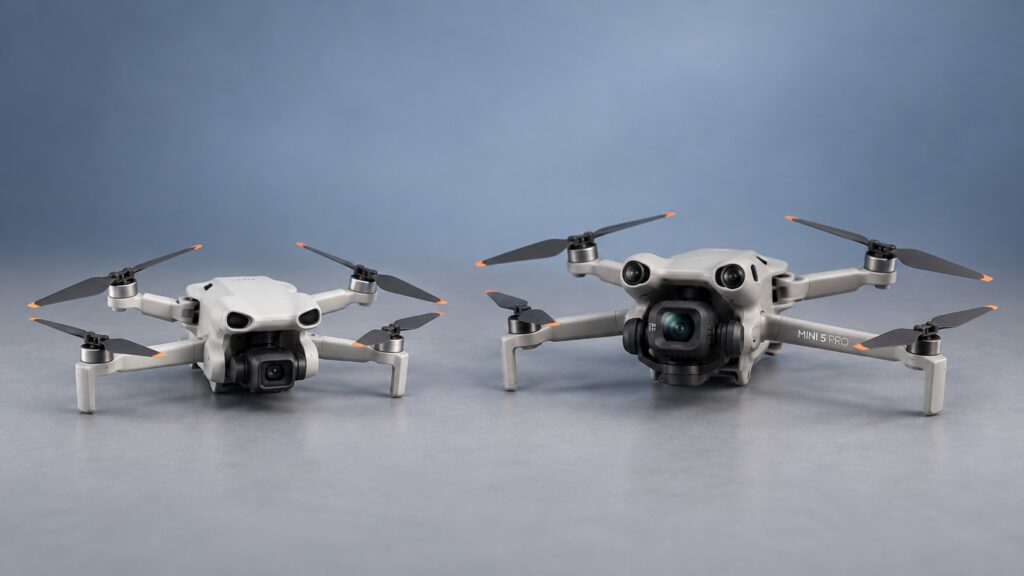
The DJI Lito X1 is my starting recommendation for travel clips, tracking and occasional slow motion. Choose the Mini 5 Pro when regular vertical filming or photography in demanding light makes its rotating camera and one-inch sensor worth the extra money.
Both standard kits use DJI’s RC-N3 phone controller. Compare those kits with each other, or compare the two RC 2 Fly More packages if you want a screen controller and spare batteries.
The UK price gap depends on the kit
DJI’s UK prices on 15 October 2026 were £369 for the X1 standard kit and £689 for the Mini 5 Pro: a £320 difference with the same controller type. Check the current retailer price when you’re ready to buy.
With a screen controller and extra batteries, the X1 Fly More with DJI RC 2 was £599 and the Mini 5 Pro Fly More with RC 2 was £979. That £380 gap is the useful comparison for a three-battery, screen-controller setup.
The money left over with X1 can fund batteries, suitable storage and the travel needed to use the drone. If the budget only stretches to a premium aircraft with one battery, consider whether a more complete X1 kit would produce more useful outings. The X1 kit comparison covers when its bundle extras earn their cost.
When the Mini 5 Pro’s larger sensor matters
Mini 5 Pro pairs a one-inch 50MP sensor with an f/1.8 lens. X1 uses a 1/1.3-inch 48MP sensor and f/1.7 lens. For this purchase, I would give the sensor-size difference much more weight than the small difference in megapixels.
The Mini’s larger sensor is particularly appealing for sunrise, sunset and high-contrast scenes. It gives you more capable camera hardware to work with when light is difficult; careful exposure and a steady flight help you make the most of it.
For bright-day landscape clips shared on a phone, X1 offers a persuasive saving. It already records 4K/60fps HDR and 10-bit D-Log M, giving you both a simple sharing route and room to learn colour grading.
Both record DNG RAW stills and 10-bit H.265 video for editing. On an older computer, try representative files in your editor before buying so you know whether playback is smooth or you will need proxies.
If you are planning a new editing computer alongside the drone, PC Builders Guide’s video-editing PC guide explains how your editor and footage codec affect processor, graphics, memory and storage choices.
Vertical framing is a stronger reason to upgrade
The Mini 5 Pro physically rotates its camera for true vertical shooting. X1’s portrait option is 2.7K vertical recording at 1512 × 2688, with a conventional non-rotating camera. If vertical delivery is a regular requirement, I would put this difference near the top of the buying decision.
A rotating camera lets you compose a tall building, waterfall or portrait scene in the intended orientation at capture. With X1, check that the available vertical framing and resolution satisfy your output. Recording a wide view first and cropping it afterwards may remove the space you need around the subject.
Mini 5 Pro’s wider controllable roll range also gives you rotating camera moves for planned sequences.
Mini 5 Pro reaches 4K/120fps slow motion; X1 reaches 4K/100fps. On a 25fps timeline, X1 already gives a straightforward four-times slowdown. I would treat the Mini’s extra frame rate as a bonus alongside its sensor and vertical camera.
Both have tracking and sensing, with different limits
X1 already has ActiveTrack, omnidirectional vision sensing and forward-facing LiDAR. Mini 5 Pro adds its upgraded ActiveTrack 360° system with Standard and Cycling options, and a different binocular vision system. A buyer moving up from a basic Mini may gain substantial assistance from either aircraft.
DJI specifies textured surfaces and more than 5 lux for X1’s vision sensing, compared with more than 1 lux for the Mini 5 Pro’s nightscape system. The Mini therefore has a wider specified low-light sensing range. Allow generous clearance around thin branches, wires and reflective surfaces, which can be difficult for either system to detect.
For tracking, choose an open area and plan a clear route with room to stop or take control. In ordinary UK Open-category flying, keep the aircraft within visual line of sight and follow the CAA’s location restrictions.
Both advertise up to 36 minutes with a standard battery under DJI’s test conditions. For an outing, budget time for wind, manoeuvres, returning and landing with a reserve. Battery endurance alone gives little reason to choose the Mini over X1.
Check the whole system before spending
RC-N3 kits require a compatible phone and DJI Fly; RC 2 kits have a built-in screen. Either aircraft can therefore suit a phone-free flying setup when bought in the appropriate package. If you already own a controller, verify the exact current compatibility and firmware requirements before relying on a drone-only purchase.
Both have 42GB of internal storage and a microSD slot. DJI lists Lexar Silver Plus A2 V30 and Kingston Canvas Go! Plus A2 V30 cards in supported capacities for both models. Match the exact range and capacity to the aircraft’s list, and make a second copy of important footage before clearing storage.
Budget for batteries, hubs, filters and propellers specified for the aircraft you choose. Check each exact model when reusing existing kit, including the hub’s charging method and power requirements.
Check the UK kit’s class label when choosing batteries. DJI distinguishes ordinary C0 packages from C1 Fly More Combo Plus packages. Its UK guidance limits the X1 Plus battery to the X1 Fly More Combo Plus aircraft; a Mini 5 Pro C0 aircraft fitted with Plus exceeds its C0/UK0 mass threshold. For either camera drone, arrange the Flyer ID and Operator ID covered by the CAA’s ID requirements before flying.
Which would I buy?
I would buy X1 for a first capable travel drone when I wanted tracking, 4K/60fps HDR and grading options without using the full budget on the aircraft. Its saving is particularly persuasive if it buys the batteries and screen controller I would otherwise leave out.
I would buy Mini 5 Pro for regular vertical filming or a photography workflow that makes its larger sensor worth paying for. Identify that requirement before buying X1 as a stepping stone; replacing a recent kit can cost more than choosing the right camera once.
Keep your existing drone when it already delivers the footage you need. If you’re moving from an older budget Mini, the X1 versus Mini 4K comparison explains the extra capability X1 brings. For other first-drone formats, use the beginner buying guide.
Technical basis: DJI’s current UK Lito X1 specifications, Mini 5 Pro specifications and model manuals, checked 15 October 2026. UK flight guidance: CAA Drone Code.