Yes. DJI says its Mini 4 Pro 360° Propeller Guard takes the aircraft over 250g. Before flying with guards, check the complete aircraft’s weight, its permitted configuration and the UK flying category that applies.
The Craznick Mini 4 Pro propeller guard on Amazon UK is a third-party option whose seller lists a 36g mass. DJI lists 84g for its complete two-sided set, covered in DJI’s official 360° guard manual (PDF). Those figures describe different guards; weigh your assembled aircraft with the exact accessory fitted and follow its restrictions.
The decision in one table
| Configuration | What the published figures say | Practical implication |
|---|---|---|
| Mini 4 Pro with standard battery | DJI lists standard take-off weight as under 249g, with actual mass varying | Keep the exact aircraft, battery and accessories within the intended configuration |
| With DJI 360° guard | DJI explicitly says the aircraft exceeds 250g; complete guard set is 84g | Plan for an over-250g configuration |
| With the named third-party guard | The seller states 36g, but gives no certified aircraft total | Weigh the complete aircraft and confirm its permitted configuration |
| With Intelligent Flight Battery Plus | DJI says the aircraft exceeds 249g and warns against adding the guard or other payload | Do not combine it with the official guard; follow the exact manual and regional rules |
Weigh the complete flying kit
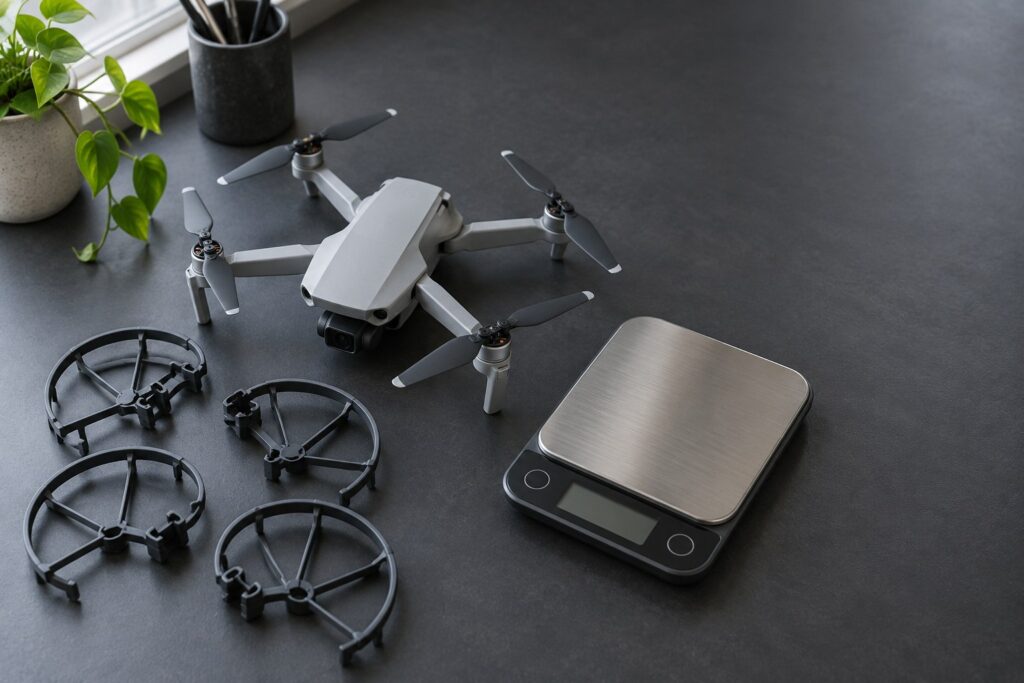
DJI’s under-249g Mini 4 Pro figure includes the standard Intelligent Flight Battery, propellers and microSD card. Actual weight can vary, so use the complete ready-to-fly kit when checking an accessory’s effect.
Include everything that leaves the ground: battery, guards, lights, landing gear, filters and other attachments. Then check the measured total against the manufacturer’s permitted combinations and the CAA’s class or weight guidance. Increasing take-off mass can affect the operating subcategory.
Starting from the upper edge of DJI’s “under 249g” statement, adding DJI’s complete 84g guard set gives a planning ceiling just below 333g: 249 + 84 = 333g.
This is a planning calculation from the stated weights. For the official guard, DJI already confirms that the fitted aircraft is over 250g; weighing your own kit is especially useful when comparing third-party accessories.
How the UK rules apply
Under the CAA’s 2026 rules, a Flyer ID is required from 100g. An Operator ID is required from 250g, or from 100g for a camera drone. A Mini 4 Pro therefore needs both IDs before you add guards. The extra weight also means reviewing the flying conditions that apply to its configuration.
Use the aircraft’s UK or European class mark, or the legacy weight rules where applicable, to find the right Open subcategory. Check the permitted modified configuration in the manual, then use the CAA’s registration and ID table and class-mark guidance to plan the flight.
European C marks have corresponding UK recognition until 31 December 2027. Adding an accessory does not certify a C0 aircraft as C1. If your planned operation relies on staying below 250g, keep the complete aircraft below that boundary and within its permitted configuration, or choose an aircraft and protection system suited to the required category.
The official Mini 4 Pro guard changes more than weight
With DJI’s 360° guard fitted, obstacle avoidance and FocusTrack are unavailable. The guard guide requires firmware v01.00.0200 or later, excludes the Intelligent Flight Battery Plus and says to avoid windy conditions. Follow its guard-detection procedure and flight limits, keeping the required separation from people.
DJI lists dimensions of 298 × 373 × 101mm unfolded with propellers, and 411.6 × 335 × 115mm with the guard installed. Allow room for that changed footprint and the extra drag when planning a flight near obstacles.
A guard can help keep a propeller from directly contacting a nearby object. On this Mini 4 Pro setup, that protection comes with extra weight, a changed footprint and disabled sensing. For outdoor practice, a large clear area gives you space to develop control while keeping people well away.
How to check your real configuration
- Use a firm, level scale. Check that it reads zero and resolves small enough increments for the decision you are making.
- Assemble the flight configuration. Fit the battery, propellers, microSD card and every accessory that will leave the ground.
- Prevent accidental start-up. Keep the aircraft powered off and remove anything the manufacturer says should not be fitted during handling.
- Record the result. A dated photo of the scale and a simple kit list are more useful than memory when accessories change.
- Check compatibility separately. A mass below a threshold does not prove that an accessory is approved, aerodynamically suitable or permitted by the manual.
Use scales on a firm, level surface and leave a sensible margin below any weight boundary. A reading close to 250g needs checking with suitable accurate scales: the displayed increment alone tells you little about measurement accuracy.
Which guard should you choose?
I would start with the DJI 360° guard and its manual (PDF) when choosing a guard for this aircraft: it gives you documented fit, installation and flight limits. Plan around its stated over-250g configuration.
For the Craznick Mini 4 Pro guard on Amazon UK, check the selected Mini 4 Pro variant, mounting instructions and final aircraft mass. Its lower seller-stated weight is useful comparison information; confirm class compliance and sensing behaviour for the fitted configuration separately.
For ordinary outdoor practice, starting without guards in a large, clear area keeps the aircraft lighter and simpler. Our Flyer ID versus Operator ID guide explains registration, while the UK guide to drones under 250g helps compare portable aircraft. Include the battery and accessories when planning the kit’s final weight.