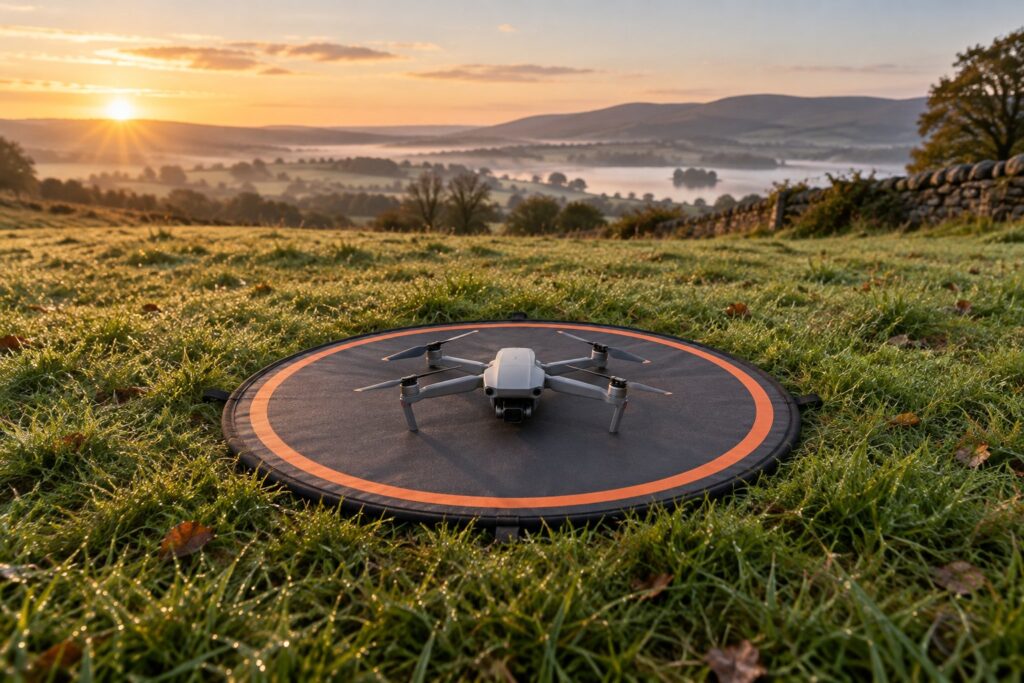
For a Mini-class drone, I recommend a 75cm landing pad as a useful balance of landing room and portability. A 55cm square suits a compact walking kit; a 110cm circle provides more working space for a larger aircraft or repeated take-offs. The examples here compare a STARTRC 55 × 55cm square with PGYTECH 75cm and Reflex Camera 110cm circles.
For a known 75cm option, compare the PGYTECH 75cm landing pad on Amazon UK. For a compact square option for a Mini-class drone, compare the STARTRC 55cm pad. For a 110cm working area, see the Reflex Camera 110cm pad. Check the selected size on the product page before ordering because some listings group variants.
55cm, 75cm and 110cm compared
| Size and shape | Best fit | Main compromise |
|---|---|---|
| 55 × 55cm square STARTRC 55cm | Mini-class drones on firm, tidy ground; hiking kits | Little room for drift, long grass at the edge or larger propeller envelopes |
| 75cm circle PGYTECH 75cm | More placement margin for Mini-class drones; check larger aircraft individually | More packed bulk than 55cm; still needs a level site |
| 110cm circle Reflex Camera 110cm | Larger aircraft, rough margins, repeatable commercial set-ups | Large wind-catching surface and much more ground area |
Size the pad around the propellers, not the folded body
Size the pad around the aircraft with its propellers extended. DJI lists the Mini 4 Pro at 298 × 373 × 101mm unfolded with propellers. To see how that fits on a round pad, use the diagonal of the length-and-width rectangle: its corners sit furthest from the centre.
A 298 × 373mm rectangle needs a circle at least as wide as its diagonal: √(298² + 373²) ≈ 477.4mm. If that rectangle is centred on a circular pad, the remaining radial margin to its corners is approximately:
75cm pad: (750 − 477.4) ÷ 2 ≈ 136mm
110cm pad: (1,100 − 477.4) ÷ 2 ≈ 311mm
On a 550 × 550mm square, the centred rectangle has a minimum straight-edge margin of (550 − 373) ÷ 2 = 88.5mm when aligned with the edges. Turning the aircraft changes that margin; turning it on a circle leaves the geometric margin the same. Use these published-dimension calculations as a sizing guide, then check the actual propeller sweep with the aircraft powered off. Allow extra room for off-centre landings, moving fabric and vegetation.
For a larger drone, check whether its published dimensions include propellers. DJI’s Mavic 3 Pro figure of 347.5 × 290.8 × 107.7mm excludes them, so its rotating span needs a separate check. Measure safely with the aircraft powered off or choose a pad with generous clearance.
Published dimension sources: DJI Mini 4 Pro specifications and DJI Mavic 3 Pro specifications.
Choose a surface and anchoring method
A landing mat helps keep loose grit and grass away from the motors and camera, and gives you a visible landing target. Lay it on firm, level ground and secure the edges before putting the aircraft on it.
Alongside size, look at how the pad packs and stays in place:
- Anchoring: pegs suit soil but not paving. Weighted edges or a naturally heavier folding panel can be more useful on hard ground.
- Surface: a wipe-clean, water-resistant material helps with damp grass. Choose a level spot where water drains away.
- Edge shape: a warped rim can become a propeller hazard. Allow a new pop-up pad to relax and keep all loops and pegs outside the rotor envelope.
- Visibility: contrast helps you see the target. Monitor the landing yourself; return-to-home accuracy and ground sensing vary with conditions.
- Packed form: the STARTRC square folds as a panel, whereas spring-frame circular pads use a different folding method. Compare packed dimensions and weight, not just deployed size.
How much clear ground will each pad need?
For circles, area grows with the square of diameter. For a square, area is side × side. The linked products therefore need different calculations.
| Diameter | Area | Relative to 55cm square |
|---|---|---|
| 55 × 55cm square | 0.303m² | 1.00× |
| 75cm circle | 0.442m² | 1.46× |
| 110cm circle | 0.950m² | 3.14× |
The square uses 0.55 × 0.55m; the circles use πr² with radii of 0.375m and 0.55m. A 110cm circle needs just over three times the ground area of the 55cm square. Find a clear patch that accommodates the whole pad and secure it using the maker’s method, with pegs away from walking routes.
Which size for each kind of flying?
Choose 55cm for a compact Mini-only kit
The STARTRC 55cm landing pad folds as a 55 × 55cm square and suits a small carrying kit. Its example minimum edge margin is 88.5mm with the aircraft centred and aligned. Check the actual propeller clearance and leave room for an off-centre landing before choosing this smaller size.
Choose 75cm as the general-purpose answer
The PGYTECH 75cm model is my general-purpose choice for a Mini-class kit. Its 75cm circle gives about 136mm of radial margin around the example rectangle, with three stakes, a nylon case and reflective stickers listed in the package. Keep vegetation clear of the propellers and check clearance again if you move to a larger aircraft.
Choose 110cm for margin and repeatable set-up
The Reflex Camera 110cm landing pad provides a 44-inch/110cm marked working area, useful for larger aircraft or repeat take-offs at an organised site. Allow 0.95m² of clear ground and secure the larger surface carefully.
Set up the pad before placing the drone
- Choose a permitted launch location with enough clear airspace.
- Check the ground for slope, stones, holes, standing water and hidden obstacles before laying the mat.
- Open a spring-frame pad away from faces and equipment, following the maker’s method.
- Secure it before placing the aircraft. Keep pegs, loops and loose fabric outside the propellers.
- Stand clear and watch for lifting edges during motor start. Stop if the surface moves or deforms.
- After landing, brush off grit before folding so it does not transfer into the drone bag.
On paving or concrete, choose a pad and securing method designed for hard ground. A weighted fold-flat panel can be easier to use there than a spring-frame pad supplied only with stakes. Check site permission and the space around the launch point first.
Our practical recommendation
Start with the PGYTECH 75cm landing pad for a balanced Mini-class kit. Choose the 55cm STARTRC alternative when packed size matters most and you’ve checked clearance, or the 110cm Reflex Camera pad when you need a larger marked area. Our beginner drone accessories guide helps you plan the rest of the kit.