Thermal imaging drones are used when a normal camera cannot show enough information on its own. Instead of only capturing visible light, a thermal drone camera detects infrared radiation and turns temperature differences into a visible image.
That makes thermal drones useful for inspections, search work, solar panels, buildings, roofs, wildlife monitoring, firefighting, utilities and other professional applications where heat patterns matter.
But thermal imaging is often misunderstood. A thermal drone does not simply “see hidden problems”. It does not see through walls in the way many people imagine. It does not automatically confirm a defect. It shows surface temperature differences, and those differences need the right conditions, suitable equipment and careful interpretation.
Used properly, thermal imaging can be extremely valuable. Used badly, it can produce misleading images that look impressive but prove very little.
👉 Drone Mapping Explained for UK Beginners
👉 Drone LiDAR Mapping Explained
👉 What Is a Drone Point Cloud?
Table of Contents
ToggleQuick Answer: What Is a Thermal Imaging Drone?
A thermal imaging drone is a drone fitted with a thermal camera. The camera detects infrared radiation from surfaces and displays temperature differences as a thermal image.
Thermal drones can help identify:
- heat loss patterns
- solar panel hotspots
- electrical overheating
- roof moisture indicators
- missing insulation patterns
- people or animals in low light
- fire hotspots
- mechanical heat issues
- pipework or heating patterns
- temperature differences across land, buildings or assets
The important word is “help”. A thermal drone image is not always a final diagnosis. It is usually an inspection tool that highlights areas worth further investigation.
A bright or dark patch on a thermal image may indicate a problem, but it can also be caused by materials, reflections, weather, moisture, angle, sunlight, emissivity or poor timing.
How Thermal Drone Cameras Work
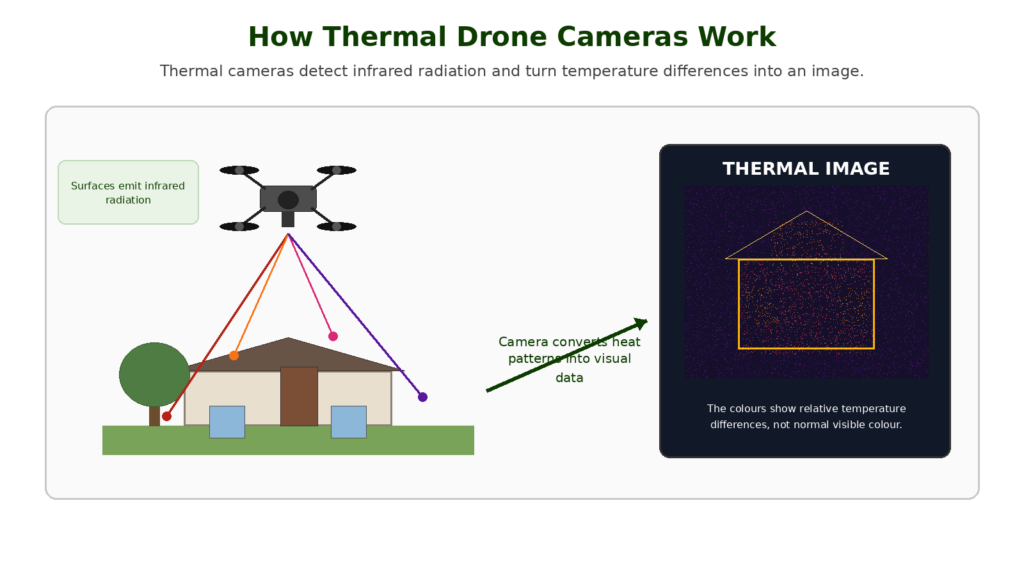
A normal drone camera captures visible light. A thermal camera detects infrared radiation.
Everything above absolute zero emits infrared radiation. A thermal camera measures that radiation and converts it into a visible image. Warmer and cooler areas appear as different colours or shades depending on the selected thermal palette.
This is why thermal images often use colours such as white, yellow, orange, red, purple or blue. The colours are not “real” colours. They are a visual way of showing temperature differences.
A thermal drone camera may show:
- hotter areas
- cooler areas
- temperature gradients
- surface temperature differences
- thermal anomalies
- heat patterns across a structure or site
Thermal imaging is most useful when there is a meaningful temperature difference to detect. If everything is the same temperature, or conditions are poor, the thermal image may not reveal much.
What Thermal Drones Can Detect
Thermal drones are useful because they can reveal temperature patterns that are not obvious in normal images.
Heat loss and insulation patterns
Thermal drones can help show heat loss patterns across roofs, walls and buildings. This can be useful for identifying areas where insulation may be missing, uneven or performing poorly.
However, a thermal image should not be treated as automatic proof of an insulation defect. External temperature, internal heating, wind, rain, building materials and time of day all affect the result.
Solar panel hotspots
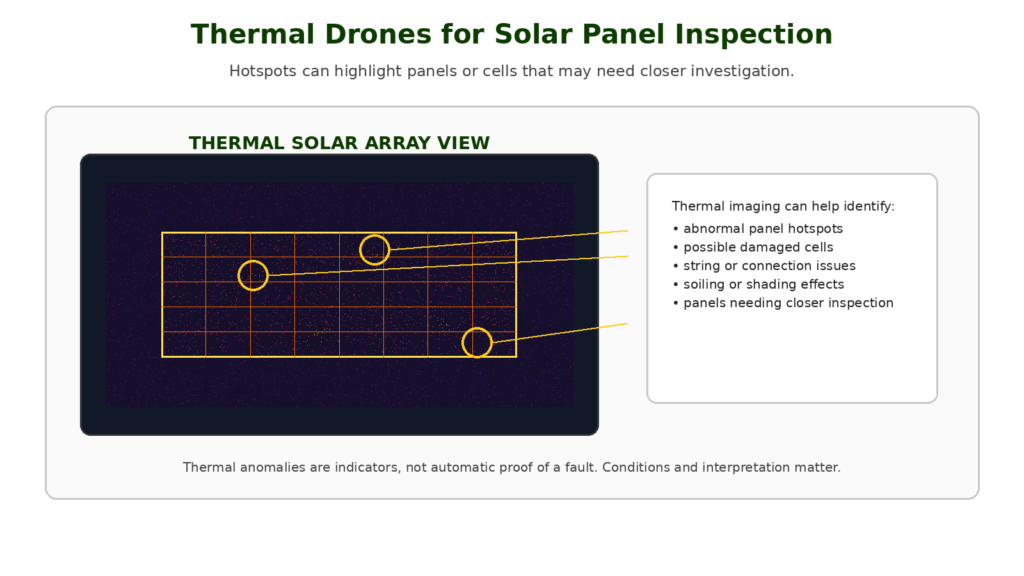
Thermal drones are widely used for solar panel inspections. Faults, damaged cells, soiling, shading, connection issues or failing components may appear as abnormal heat patterns.
A drone can cover large solar arrays more efficiently than a manual inspection from the ground. The thermal image helps identify panels or strings that may need closer inspection.
Roof moisture indicators
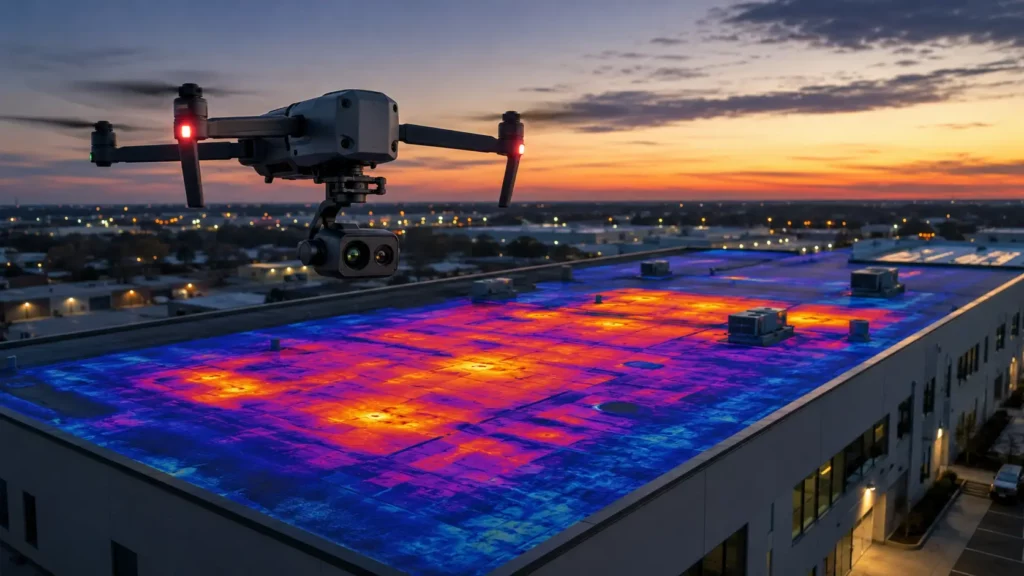
Moisture can sometimes affect thermal patterns on roofs because wet areas can heat and cool differently from dry areas. This can make thermal imaging useful for some flat roof inspections.
But thermal imaging does not directly “see water”. It detects surface temperature differences that may be associated with moisture. The result needs careful interpretation and, where necessary, confirmation by other inspection methods.
Electrical and mechanical hotspots
Thermal cameras can help identify overheating equipment, connections, motors, bearings, plant, machinery or electrical components.
This can be valuable because abnormal heat may indicate stress, poor connections, overload, friction or failing parts.
Wildlife and search work
Thermal drones can help detect people or animals because living bodies often appear warmer than the surrounding environment.
This can be useful for search and rescue, deer counting, wildlife monitoring, livestock checks and security work. Conditions matter, though. Dense vegetation, buildings, water, terrain and weather can all affect detection.
Fire and emergency response
Thermal drones can help identify hotspots, fire spread, retained heat, hidden smouldering areas and temperature differences during emergency response.
They can provide useful overhead situational awareness, especially where it is unsafe or difficult for people to access an area.
What Thermal Drones Cannot Do
Thermal imaging is useful, but it has limits. Understanding those limits is what separates serious thermal drone work from exaggerated marketing.
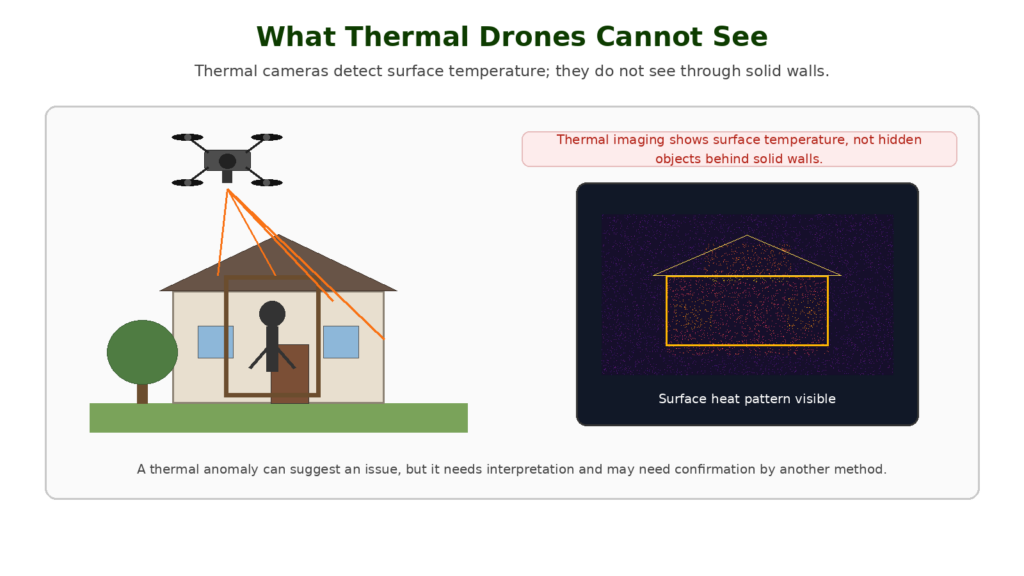
Thermal drones do not see through walls
A thermal camera detects surface temperature. It does not normally see through walls, roofs, ceilings or solid objects.
If there is a heat pattern on the outside surface, the camera may show that pattern. But it is not directly showing what is inside the wall.
Reflective surfaces can mislead results
Some surfaces reflect infrared radiation. Metal, glass, water and shiny materials can produce misleading thermal readings because the camera may detect reflected heat rather than the true surface temperature.
This is one reason thermal inspection requires care. A bright thermal area is not automatically a hot object.
Weather and timing matter
Thermal work is heavily affected by conditions.
Wind can cool surfaces. Rain can change temperature patterns. Strong sunlight can heat materials unevenly. Recent shade, cloud cover, building heating cycles and time of day can all change what the camera sees.
For many building and roof inspections, timing is critical. The wrong conditions can make a thermal survey much less useful.
Thermal images need interpretation
A thermal image may show an anomaly, but interpretation is the important part.
The operator needs to understand the likely cause of the pattern and whether it is meaningful. A thermal anomaly may be caused by a real defect, but it may also be caused by material differences, reflection, airflow, moisture, sunlight, angle or background temperature.
A thermal anomaly is not a confirmed defect
Thermal imaging often identifies areas that need further checking. It should not be overused as final proof unless the workflow, conditions and supporting evidence justify that conclusion.
Radiometric vs Non-Radiometric Thermal Cameras
One of the most important thermal drone buying distinctions is whether the thermal camera is radiometric.
A radiometric thermal camera records temperature data for each pixel or measurement area. This allows the user to analyse temperatures after capture, adjust parameters and create more useful inspection outputs.
A non-radiometric thermal camera may show a thermal image but may not provide the same level of temperature measurement or post-analysis.
This matters for professional work.
For casual searching or simple heat detection, a basic thermal view may be useful. For inspections, reports, solar analysis or building diagnostics, radiometric data is far more valuable.
A serious thermal drone buyer should check:
- whether the camera is radiometric
- thermal resolution
- temperature measurement range
- measurement accuracy
- thermal sensitivity
- available palettes
- image format
- analysis software support
- whether radiometric data can be exported and reviewed
A cheaper thermal drone may still detect heat, but it may not provide the data needed for professional reporting.
Thermal Drone Resolution Explained
Thermal resolution matters because thermal cameras usually have much lower resolution than normal visual cameras.
A normal camera might shoot high-resolution photos or 4K video. A thermal camera may have a much lower pixel count.
For example, a 640 × 512 thermal sensor is significantly more useful than a very low-resolution thermal sensor because it captures more thermal detail. This can matter for solar panel inspections, roof surveys, electrical hotspots, search work and any inspection where small temperature differences or small targets matter.
Lower-resolution thermal cameras can still be useful, but they may require flying closer, accepting less detail or using them only for broader heat detection.
When comparing thermal drones, do not only look at the visible camera. Check the actual thermal sensor resolution.
Thermal Sensitivity and NETD
Thermal sensitivity is another important specification. It is often expressed as NETD, which stands for Noise Equivalent Temperature Difference.
In simple terms, NETD indicates how small a temperature difference the camera can detect. A lower NETD usually means better thermal sensitivity.
This matters because not every useful thermal anomaly is dramatic. Some faults or heat patterns are subtle. A more sensitive thermal camera can show smaller differences more clearly.
For professional inspection work, thermal sensitivity can be just as important as headline resolution.
Thermal Drones for Roof Inspections
Thermal drones can be useful for roof inspections, especially when looking for heat patterns, insulation issues or possible moisture-related anomalies.
They are particularly relevant for:
- flat roofs
- commercial roofs
- large buildings
- industrial units
- roof heat loss patterns
- moisture indicators
- solar panel roof installations
- hard-to-access roof areas
However, thermal roof inspection is condition-dependent. The time of day, recent weather, roof material, internal heating, wind and sun exposure all affect the result.
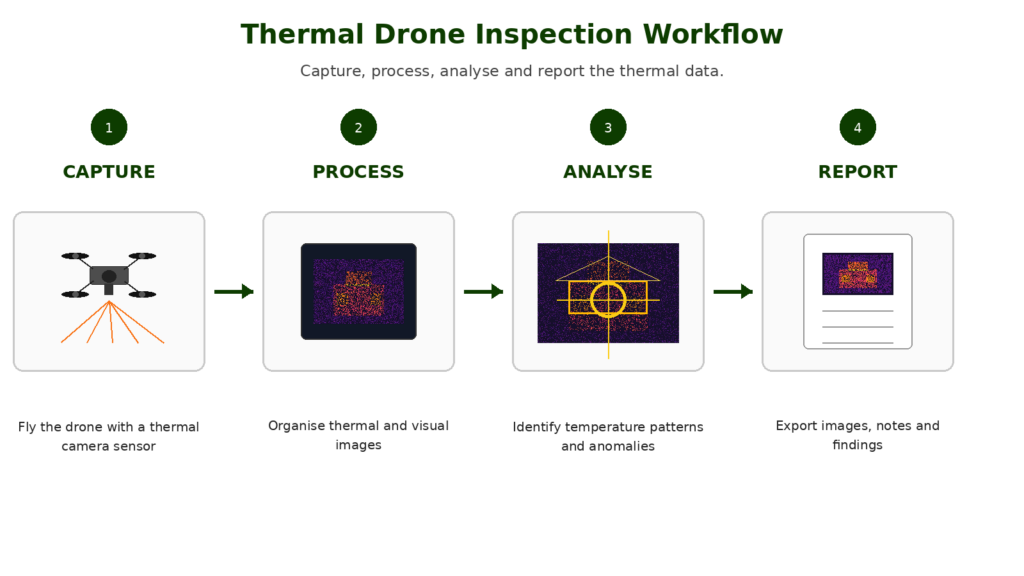
For many roof jobs, the best workflow may combine:
- normal RGB images
- close-up roof photography
- oblique angles
- thermal imagery
- inspection notes
- follow-up checks
A thermal drone can highlight suspicious areas, but it does not replace building knowledge or proper roof inspection.
👉 Best Drone for Roof Inspections UK
Thermal Drones for Solar Panel Inspections
Solar panel inspection is one of the strongest use cases for thermal drones.
A thermal drone can help identify abnormal heat patterns across panels or arrays. These may indicate:
- defective cells
- damaged panels
- soiling
- shading problems
- string issues
- connection faults
- inverter or electrical issues
- underperforming modules
Large solar sites can be time-consuming to inspect from the ground. A drone can capture thermal data from above more efficiently and help prioritise panels for closer investigation.
The inspection still needs the right conditions. Irradiance, weather, panel angle, wind, time of day and image angle all affect the quality of the result.
For solar work, radiometric thermal data and proper reporting are important.
👉 Best Drone for Solar Panel Inspections UK
Thermal Drones for Buildings and Heat Loss
Thermal drones can help show heat loss patterns across buildings.
They may be useful for:
- commercial buildings
- industrial units
- warehouses
- schools
- estates
- large domestic properties
- roof insulation checks
- heat loss surveys
- identifying unusual surface temperature patterns
A thermal drone can be especially useful where a building is large, difficult to access or where a roof-level view is needed.
However, building thermography requires caution. External conditions, internal heating, insulation type, material differences, ventilation and thermal bridging can all affect the image.
A thermal image may suggest a problem, but it needs to be interpreted in context.
Thermal Drones for Wildlife and Search
Thermal drones can help detect people and animals because warm bodies often contrast with cooler surroundings.
Common uses include:
- search and rescue support
- missing person searches
- deer counting
- wildlife monitoring
- livestock checks
- security patrols
- night-time detection where authorised
Thermal drones can be very useful in open areas, fields, woodland edges and low-light environments. But they are not perfect.
Dense vegetation, buildings, terrain, weather, distance and background temperature can all affect detection. A person or animal hidden under dense cover may not be visible.
For search work, thermal drones are a tool, not a guarantee.
Thermal Drones for Fire and Emergency Response
Thermal drones can support fire and emergency response by showing heat patterns from above.
They may help with:
- locating hotspots
- identifying retained heat
- monitoring fire spread
- checking roofs or structures
- assessing difficult-to-access areas
- improving situational awareness
- reducing risk to people on the ground
This can be valuable because some hotspots may not be obvious in a normal image.
However, emergency use requires proper training, coordination and permissions. Flying a drone near emergency operations without authorisation can create serious risks.
Thermal Drones for Agriculture and Land Work
Thermal imaging can also support some agricultural and land-based workflows.
It may help with:
- livestock detection
- irrigation issues
- crop stress indicators
- soil moisture patterns
- drainage differences
- wildlife management
- environmental monitoring
Thermal data can be useful, but it is usually only one layer of information. Agriculture may also use RGB imagery, multispectral sensors, NDVI-style outputs and other mapping methods depending on the goal.
What Drone Do You Need for Thermal Imaging?
The right thermal drone depends on the job.
For simple heat detection, a lower-cost thermal drone may be enough. For inspection, solar work, building surveys or professional reporting, a better thermal camera and stronger software support are usually needed.
Important features include:
- thermal sensor resolution
- radiometric capability
- thermal sensitivity
- visible camera quality
- zoom capability
- flight time
- obstacle sensing
- RTK where mapping accuracy matters
- reporting and analysis software
- image format and export options
- payload compatibility
- support ecosystem
A thermal drone should not be chosen only by brand or price. It should be chosen by the inspection task and the quality of output required.
👉 Best Thermal Drone UK
Is a Thermal Drone Worth It?
A thermal drone is worth it when the use case genuinely needs heat data.
It may be worth it for:
- solar panel inspections
- roof and building surveys
- electrical inspection support
- fire and emergency work
- wildlife and search operations
- industrial sites
- utilities
- large estates
- land and livestock checks
- professional inspection workflows
It is probably not worth it if the buyer mainly wants:
- normal aerial photos
- casual flying
- social media footage
- beginner drone practice
- simple roof photos
- low-cost hobby use
Thermal drones are more expensive because the sensor and software matter. A buyer should only pay the extra cost when thermal data is useful for the work they actually need to do.
UK Drone Rules and Professional Thermal Work
Thermal imaging does not change the basic drone rules by itself. The rules still depend on the drone, weight, class, location, operation and risk level.
Many thermal drone use cases involve buildings, people, commercial sites, industrial areas, emergency work, infrastructure or night operations. These can raise the complexity of the flight.
Some drone operations may fit within the Open Category, but more complex work may require Specific Category authorisation, insurance, permissions, risk assessment and suitable pilot competency.
Privacy and data protection can also matter. Thermal imagery may reveal information about people, buildings, activity or property. Professional thermal work should be planned carefully and handled responsibly.
This guide is for general technical information only and is not legal advice. Anyone carrying out professional thermal drone work in the UK should check current CAA guidance and make sure the operation is properly planned and authorised.
👉 Do You Need a Licence to Fly a Drone in the UK?
👉 Flyer ID vs Operator ID Explained
Common Thermal Drone Mistakes to Avoid
There are several mistakes that can make thermal drone work misleading.
The first is assuming thermal cameras see through walls. They usually detect surface temperature, not what is hidden inside a structure.
The second is ignoring emissivity. Different materials emit and reflect infrared radiation differently, which can affect the apparent temperature.
The third is trusting shiny or reflective surfaces too much. Metal, glass and water can produce misleading readings because they may reflect heat from elsewhere.
Another mistake is flying at the wrong time. Strong sun, recent rain, wind or poor temperature contrast can make thermal data much less useful.
It is also easy to overstate what a thermal anomaly proves. A hot or cold patch may suggest an issue, but it may need confirmation.
Finally, buyers sometimes focus only on the drone and ignore the sensor. With thermal drones, the thermal camera specification is often more important than the normal camera specification.
Final Verdict: Why Thermal Imaging Drones Matter
Thermal imaging drones matter because they show temperature differences that normal cameras cannot.
They can be valuable for solar panel inspections, roof surveys, building heat loss, electrical hotspots, wildlife detection, search work, fire response and industrial inspections.
But thermal drones need to be used carefully. They detect surface temperature patterns, not hidden truths. Weather, timing, materials, reflections, emissivity, camera resolution and interpretation all affect the result.
For simple visual inspection, a normal drone may be enough. For work where heat patterns matter, a thermal drone can add a valuable layer of information.
The important buying lesson is simple: choose a thermal drone based on the quality of thermal data required, not just the drone platform. Radiometric capability, thermal resolution, sensitivity, software and workflow all matter.
FAQ
What is a thermal imaging drone?
A thermal imaging drone is a drone fitted with a thermal camera. It detects infrared radiation and displays temperature differences as a thermal image.
What can thermal drones detect?
Thermal drones can detect temperature differences across surfaces. They can help identify heat loss patterns, solar panel hotspots, electrical overheating, fire hotspots, people, animals and some moisture-related indicators.
Can thermal drones see through walls?
No. Thermal drones usually detect surface temperature. They do not see through walls in the way many people imagine.
Can thermal drones find roof leaks?
They may help identify thermal patterns associated with moisture, especially on some flat roofs, but they do not directly see water. Any suspected issue should be confirmed with suitable inspection methods.
Are thermal drones good for solar panel inspections?
Yes. Solar panel inspection is one of the strongest use cases for thermal drones because faulty or underperforming panels can show abnormal heat patterns.
What is a radiometric thermal camera?
A radiometric thermal camera records temperature data, allowing images to be analysed in more detail after capture. This is important for professional inspection and reporting.
What thermal resolution is good for a drone?
Higher thermal resolution gives more useful detail. A 640 × 512 thermal sensor is much stronger than a very low-resolution thermal camera for many professional inspection tasks.
What is NETD in thermal imaging?
NETD stands for Noise Equivalent Temperature Difference. It describes thermal sensitivity. Lower NETD usually means the camera can detect smaller temperature differences.
Is a thermal drone worth buying?
A thermal drone is worth buying if the work genuinely needs heat data, such as solar inspection, building heat loss, search work, fire response or industrial inspection. It is usually not worth it for casual aerial photography.
Can thermal drones be used at night?
Yes, thermal cameras can be useful at night because they do not rely on visible light in the same way as normal cameras. However, night flying must follow the relevant drone rules and safety requirements.
What is the best thermal drone?
The best thermal drone depends on the job, budget, sensor resolution, radiometric capability, flight time, software and whether the work involves inspection, search, solar, buildings or industrial assets.
Do thermal drones need RTK?
Not always. RTK may be useful where accurate mapping or repeatable data positioning matters, but many thermal inspection jobs depend more on sensor quality, timing and interpretation.
Are thermal drone images accurate?
They can be useful, but accuracy depends on camera quality, emissivity settings, distance, reflected temperature, weather, angle, material and interpretation.
Can thermal drones detect people?
Yes, thermal drones can help detect people because the human body often contrasts with the surrounding environment. Detection can still be affected by distance, cover, vegetation, buildings and weather.
Do you need permission for thermal drone inspections in the UK?
Permission requirements depend on the location, operation, drone and risk level. Professional thermal work may require site permission, insurance, risk assessment and possibly Specific Category authorisation.